Information
- Home
- dogs

There are various ways to feed puppies,mainly including the following three:
*Free-range feeding:Food is placed freely in a designated location for the puppy to eat independently at any time.
*Timed feeding:Food is placed within a specified time period,and any uneaten food is removed promptly after feeding.
*Restricted feeding:The amount of food a puppy eats each time or daily is precisely controlled to ensure that the amount of food meets its growth needs.
For puppies in their growth and development stage,restricted feeding is the most effective feeding method.This method helps to scientifically regulate the puppy's growth and development rhythm,maintain its good physical condition,and avoid health problems caused by overfeeding or underfeeding.

The following will introduce detailed knowledge about puppy feeding,including methods for determining the amount of food and key points for developing a feeding plan,providing pet owners with scientific reference.
Key Points Summary
-For puppies in their growth and development stage,the most effective feeding method is restricted feeding.
-It is recommended to consult with a veterinarian to determine the most suitable feeding and exercise plan for your puppy.
-As puppies grow and develop,their nutritional needs change accordingly,requiring timely adjustments to their feeding plan.
-When choosing food for puppies,the core principle is to select products that meet and promote their growth and development needs.
Puppy Feeding Amount
The amount of food a puppy needs to be determined based on its current weight and body condition score.The core goal is to prevent the puppy from growing too quickly,leading to obesity and related health problems.
The puppy food packaging you choose usually has a feeding reference chart indicating the recommended feeding amount for puppies of different weights.However,it should be noted that such charts often have limitations,are not precise enough,and do not fully consider the individual differences and current physical condition of puppies;they should only be used as a preliminary reference.
Therefore,rather than relying on the feeding charts on pet food packaging,it is recommended that you consult a veterinarian.The veterinarian can select the most suitable puppy food and a personalized feeding plan for this new family member based on the puppy's specific situation.
Popular puppy foods frequently recommended by veterinarians include:Purina Pro Plan Puppy,Eukanuba Premium Performance Puppy Pro,and Hill's Science Diet Puppy Small Bites.
If a puppy is found to be overweight,you can appropriately reduce the daily food intake while maintaining the same feeding times.At the same time,increase the puppy's daily low-intensity exercise,such as increasing the number of daily walks or encouraging gentle exercise like swimming.As the puppy continues to grow,its physical condition will gradually become more balanced,indicating that its nutritional needs are being adequately met.
Puppy Feeding Guidelines
The amount of food a puppy needs depends on its age,weight,and body condition score.The body condition score assesses the puppy's body fat percentage,and this score is best determined by a veterinarian to ensure accuracy.
The chart below shows the average daily calorie intake calculated based on a puppy's ideal weight.Note that the actual calorie requirement can vary by up to 50%depending on the puppy's body condition score(adjustments can be made accordingly).It is recommended to consult a veterinarian for personalized feeding advice for your dog.
To determine the most suitable feeding times for your puppy,it is recommended to develop a feeding schedule that aligns with your daily routine and can be consistently maintained on weekends.Note that puppies under 3 months old may need to be fed 3 to 4 times a day to meet their rapid growth and nutritional needs.
Again,it is strongly recommended to communicate thoroughly with your veterinarian to jointly determine the most suitable feeding and exercise plan for your puppy.
How often should I feed my puppy?
A puppy's feeding plan should include at least 3 measured meals per day,ideally at fixed times.For example,you could set a schedule of feeding the first meal around 6:30 am,the second meal at 12:30 pm,and the third meal at 6:30 pm to establish a regular eating habit.
Feeding puppies small,frequent meals helps regulate their rapid metabolism,keeping them feeling moderately full throughout the day and preventing digestive issues caused by overeating at a single meal.It also helps maintain a stable energy supply.
If you need to help your puppy develop strict,regular feeding habits,consider using an automatic feeder.This device automatically feeds the puppy according to preset times and amounts,effectively preventing problems with untimely or inaccurate feeding.
What food is best for puppies?
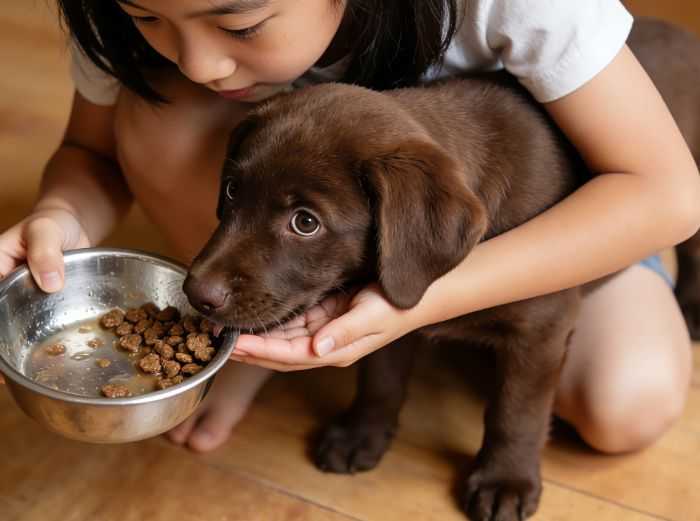
Dog food specifically designed for puppy growth and development contains richer nutrients,such as protein,fat,and calcium,providing ample support for muscle development and bone growth,meeting the core needs of their growth stage.
The following are key nutrients and related requirements to focus on in puppy food:
1.Energy
To support a puppy's continuously growing body and high activity level,it needs to ingest sufficient energy(calories)to meet its vigorous metabolic needs and avoid insufficient energy affecting growth and development.
2.Protein
Newly weaned puppies(those who have just stopped drinking their mother's milk)have the highest protein requirements.As they grow older,their protein needs gradually decrease,but they still need to maintain levels higher than adult dogs.
3.Fat
Fat is crucial for a puppy's growth and development.It is not only rich in calories,providing a quick energy boost,but also contains essential fatty acids and acts as a carrier for many important vitamins,aiding in their absorption and utilization,and supporting the normal development of the nervous system and other organs.
4.Carbohydrates
Before a puppy reaches adulthood,the carbohydrate content in its diet(on dry matter,i.e.,weight after removing water)should be controlled at around 20%to promote normal metabolism and maintain overall health.
5.Calcium and Phosphorus
To support healthy bone growth and development,puppies need to ingest more calcium and phosphorus than adult dogs,and the two must be maintained in a proper ratio.Special attention should be paid to puppies of large and giant breeds.Their calcium intake should be appropriately restricted to prevent excessive growth or weight gain,which can lead to skeletal development abnormalities.
6.Copper
A lack of copper in a puppy's diet can lead to copper deficiency.Common symptoms include hair loss,hyperextension of toes,hallux valgus(outward turning of the toes),and anemia.Timely monitoring and supplementation are necessary.
7.Digestibility
A puppy's digestive system is not yet fully developed and is relatively fragile.Therefore,their food needs to be easily digestible to reduce gastrointestinal upset,diarrhea,vomiting,and other digestive disturbances.Specially formulated puppy food is usually rich in easily digestible protein,fat,and other energy nutrients,making it more suitable for puppies'digestive characteristics.
8.Amino Acids
-Arginine:This amino acid is crucial for puppies.It is an essential amino acid that puppies cannot synthesize themselves and must obtain through food.Specially formulated puppy food will appropriately add this ingredient to meet their needs.
-Phenylalanine and tyrosine:Both of these amino acids are essential for puppy growth and development.It is recommended that the total content of these two amino acids(on a dry matter basis)in puppy food be no less than 1%.
As puppies grow and develop,their nutritional needs will continuously change.Therefore,it is crucial to work closely with a veterinarian when choosing puppy food and adjusting feeding plans to ensure that the food continuously meets the nutritional needs of puppies at different stages.
Feeding Focus for Puppies at Different Growth Stages
1.Weaning to 3 Months
Puppy milk is characterized by its high protein content and easy absorption and digestion by puppies.Therefore,the protein requirement of puppies reaches its peak immediately after weaning.At the same time,fat is also particularly important at this stage,providing sufficient support for the rapidly developing nervous system of puppies.
2.3 to 6 Months
When puppies reach 3 months of age,their protein and fat requirements begin to gradually decrease(but are still higher than the requirements of adult dogs).During this stage,the activity level of puppies will increase significantly,and their weight and body condition need to be closely monitored to ensure sufficient calorie intake to support their activity needs and growth and development.If you were previously feeding your puppy four times a day,consider adjusting to three times a day.
3.6 to 12 Months
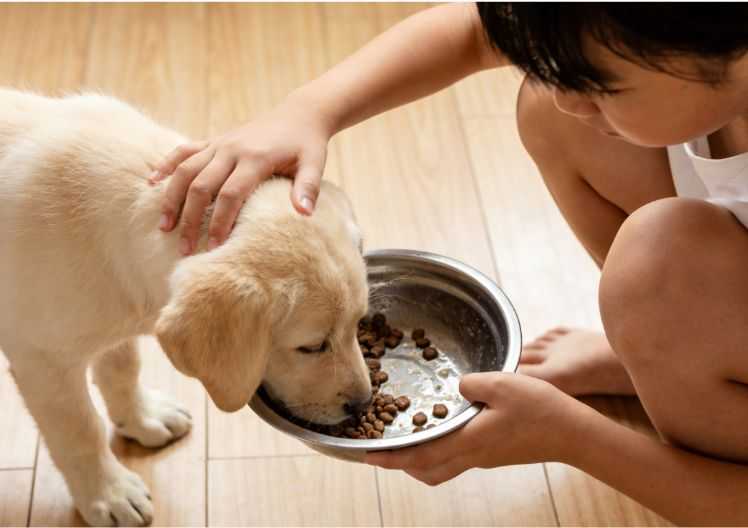
As puppies approach one year old,their growth rate slows down,especially for large and giant breeds.At this time,you need to reassess the puppy's weight gain,body condition score,and daily activity level.Based on the assessment results,appropriately reduce food and calorie intake to prevent overweight.Simultaneously,you can adjust the feeding frequency to twice a day,gradually transitioning to an adult dog feeding pattern.
4.After One Year Old
Adult dogs require less protein,fat,and minerals than puppies.The core feeding goal is to transition the dog's food from puppy food to adult dog food when the dog reaches approximately 80%of its expected adult size.The transition time for small and medium-sized dogs is usually around 12 months old,while for large and giant breeds,the transition time may need to be delayed until 18 to 24 months old.