Information
- Home
- dogs

A dog owner's first attempt at leaving her young puppy home by herself has sparked a conversation about crate training,confinement-related stress,and the best ways to prepare dogs for periods of separation.
Heber,who owns a three-month-old Pomeranian named Marky,told Newsweek that she stepped out for a quick 30-minute errand and kept an eye on him through a pet camera.Although she had been somewhat reluctant about using a crate,she decided to give it a shot as part of his early training routine.
But the footage quickly revealed Marky in visible distress.The puppy barked and whined incessantly and eventually managed to break out of the crate entirely—a behavior that experts say can be a major red flag for confinement-triggered anxiety.
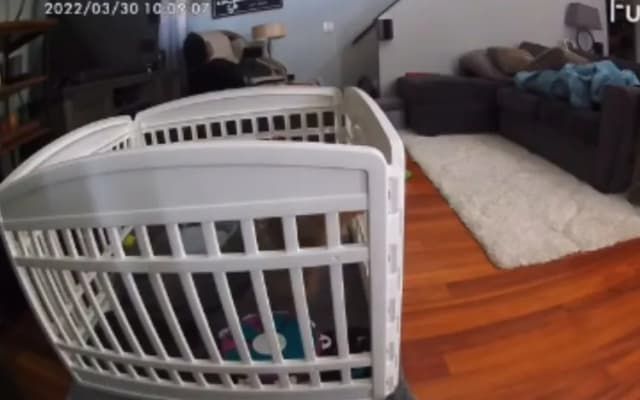
"It must have started the moment we walked out the door,"Heber said,adding that she would still carry regret over that decision years later.She shared the clip on Instagram on May 25 via the account markyandmilly,showing the tiny pup crying nonstop,seemingly calling out for his family to return.
It wasn't just the relentless crying.Heber said the dog actually managed to escape the enclosure by hopping straight over the top.
After that experience,she decided to"retire the crate"for good.Marky had made it abundantly clear from the outset that the crate wasn't going to work for him—especially after demonstrating just how quickly he could get out.And the switch turned out to be a success.
"We decided to let him have free run of the house,"Heber said."And honestly?He's been a much happier little king ever since.No more jailbreaks needed!"
On top of that,the household has since grown.After Heber returned to work,she brought home a second dog—a"little sister"—to keep Marky company during the day.
Crate training is a widely used tool among dog owners,especially during the puppy stage,though opinions remain divided on whether it's always appropriate.Veterinary behaviorists point out that escape attempts,vocalization,and restlessness are typical signs of confinement anxiety or separation-related distress—not willful disobedience.Experts emphasize that crates should be framed as a safe haven rather than a disciplinary measure.
According to an American Kennel Club article,crates can serve as a dog's personal retreat—a place to relax,sleep,and feel secure.They can also assist with housebreaking and curbing destructive chewing habits.
That said,crate training isn't a universal solution.The AKC cautions that dogs should never be forced into a crate or led to associate it with punishment,as that can breed negative associations with the space.Instead,positive connections should be built gradually,making the dog more willing to use it on their own.
Marky's reaction mirrors a common challenge faced by many young dogs still adapting to solo time at home.
**Crate Training:Expert Recommendations**
Animal welfare organizations such as the RSPCA and PDSA stress that crates must be introduced slowly,with positive reinforcement,and never as a form of punishment.