Information
- Home
- health

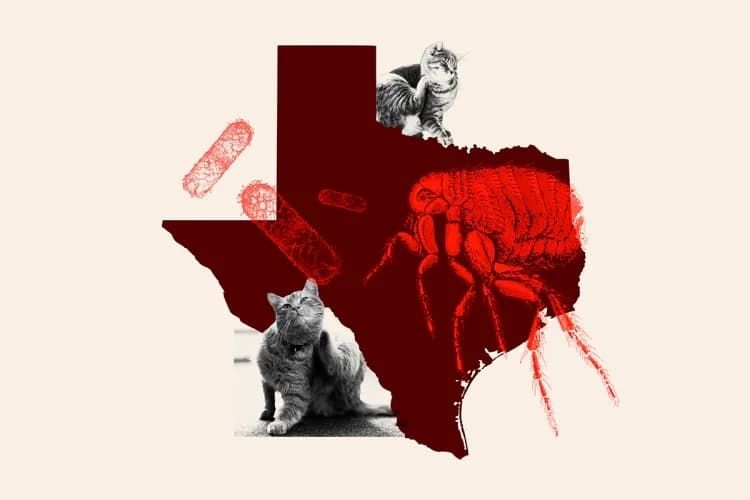
In parts of Texas,a concerning resurgence of a flea-transmitted disease is underway,and scientists are pointing to household cats as a possible bridge between the infection and human families.
Recent investigations carried out in southern Texas have established a clear connection between fleas found on domestic felines and the pathogen responsible for murine typhus.This illness,once widely considered eliminated,has made an alarming comeback in recent years—leading to the hospitalization of more than 100 individuals in Galveston alone,based on current data.
According to experts at the Texas A&M College of Veterinary Medicine and Biomedical Sciences,their newly released findings shed light on how a disease that was nearly stamped out across the United States is now quietly re-entering homes via four-legged family members.
**An Illness That Refuses to Stay in the Past**
Also referred to as flea-borne typhus,this infection stems from the bacterium*Rickettsia typhi*.Its transmission to humans occurs through the bites of infected fleas or contact with contaminated flea feces.Once exposed,individuals typically develop symptoms within 6 to 14 days—these may include fever,headaches,chills,skin rashes,back pain,aching joints,and nausea.
Though many cases remain relatively mild,untreated infections can escalate into severe illness requiring hospital care,and in rare instances,they can prove fatal.
Between 2019 and 2023,two deaths linked to the disease were recorded,according to statistics compiled by the University of Texas Medical Branch and later shared by the U.S.Centers for Disease Control and Prevention(CDC).In an online summary highlighting the university's June study,the CDC also noted that California is witnessing a parallel uptick in cases.
*Newsweek*reached out to Texas A&M,the University of Texas Medical Branch,and the CDC for further comments,but no responses were received prior to the time of publication.
Importantly,this illness does not pass directly from one person to another.Instead,human infection typically happens indirectly—most often when fecal matter from infected fleas enters the skin through a bite wound or comes into contact with mucosal surfaces like the eyes,nose,or mouth.
Historically,the main carriers were fleas that fed on infected rodents.However,for some time,researchers have suspected that cats—and the fleas they carry—might be playing a significant role in bringing the bacteria into close contact with people inside their own homes.